

Greenwashing is one of the most frustrating traps in modern fashion. You pick up a hoodie labeled “organic cotton,” pay a premium for it, and later realize the claim was backed by nothing more than a marketing team’s imagination. For style-conscious shoppers in Europe who care about both aesthetics and ethics, this is a real problem. Authentic organic apparel goes far beyond a label. It requires verified certification, supply chain oversight, and genuine brand transparency. This guide walks you through every step you need to confidently identify the real thing, whether you’re building a minimalist capsule wardrobe or curating a sustainable streetwear rotation.
Table of Contents
- Why authenticity matters in organic apparel
- Certifications and labels: The gold standards decoded
- Step-by-step: How to verify authenticity before you buy
- Red flags: Common signs of greenwashing and fake organic apparel
- Aligning your values: Minimalist streetwear, EU compliance, and trusted brands
- Discover truly authentic organic streetwear
- Frequently asked questions
Key Takeaways
| Point | Details |
|---|---|
| Check for real certifications | Authentic organic apparel always carries verifiable certifications like GOTS with a license code. |
| Verify online before buying | Always confirm certification numbers in official public databases to avoid greenwashing. |
| Beware red flags | Vague claims, fake logos, low prices, and missing transparency often signal fakes. |
| Minimalist and streetwear can be ethical | Prioritize EU-made, fully certified apparel to align style with authentic sustainability. |
Why authenticity matters in organic apparel
The stakes are higher than most people realize. When a brand makes an unverified “organic” claim, it doesn’t just mislead you. It undermines the entire ecosystem of farmers, manufacturers, and brands doing the hard work of genuine sustainability. Choosing organic clothing is a meaningful act, but only when the product actually delivers on its promise.
The environmental case is compelling. Organic cotton reduces GWP by 46% and water use by 91% compared to conventional cotton. That’s a massive difference. But those numbers only apply to genuinely certified organic production, not to garments that simply use the word “organic” on a hangtag.
In Europe, the regulatory landscape is tightening. The EU Green Claims Directive requires brands to substantiate any environmental or sustainability claim with verifiable proof. Vague language like “eco-friendly” or “natural” without certification is increasingly a legal risk for brands, not just a consumer trust issue. Understanding what counts as organic clothing under these standards is the first step toward smarter shopping.
Here’s what authentic organic apparel actually delivers:
- No toxic pesticides or synthetic fertilizers in the growing process
- Safer chemical processing throughout dyeing and finishing
- Ethical labor standards verified by third-party auditors
- Full supply chain traceability from farm to finished garment
- Alignment with EU regulations including REACH chemical safety standards
“Organic” without certification is just a word. Real authenticity requires a paper trail that goes all the way back to the field.
For minimalist and streetwear consumers, this matters on a style level too. Brands that invest in genuine certification tend to invest equally in fabric quality, construction, and design integrity. The two go hand in hand.
Certifications and labels: The gold standards decoded
Not all certifications are equal. Knowing which ones actually mean something, and what each one covers, is the foundation of smart organic apparel shopping. Let’s break down the three you’ll encounter most often.
GOTS (Global Organic Textile Standard) is the benchmark. It covers the entire supply chain, from raw fiber to finished garment, including processing, dyeing, and social criteria like fair wages and safe working conditions. GOTS is the gold standard for European consumers who want farm-to-garment assurance. You can verify any GOTS claim using their public supplier database.

OCS (Organic Content Standard) is more limited. OCS verifies organic fiber content and chain of custody but does not cover processing chemicals, dyeing practices, or labor standards. It’s a useful starting point but not a complete picture of a garment’s sustainability.
OEKO-TEX Standard 100 tests the finished product for harmful substances. OEKO-TEX tests for harmful substances but does not verify whether the fiber is organically grown. A garment can pass OEKO-TEX and still be made from conventional cotton.
| Certification | Covers organic fiber | Covers processing | Covers labor | Verifiable database |
|---|---|---|---|---|
| GOTS | Yes | Yes | Yes | Yes |
| OCS | Yes | No | No | Yes |
| OEKO-TEX 100 | No | Partial | No | Yes |
Here’s how to prioritize them when shopping:
- Always look for GOTS first. It’s the most complete standard.
- Accept OCS as a secondary signal, not a standalone guarantee.
- Treat OEKO-TEX as a bonus, not a replacement for organic certification.
- Check the organic clothing basics to understand what each label means in practice.
- Cross-reference any label with the certifier’s public database before purchasing.
Brands like Stanley/Stella have built their reputation on GOTS certification, and it shows in both their product quality and their transparency. That’s the kind of brand behavior worth rewarding.
Pro Tip: Never trust a certification claim based on a hangtag alone. Go to the GOTS suppliers database and enter the license number yourself. It takes 30 seconds and removes all doubt.
Step-by-step: How to verify authenticity before you buy
Knowing what each label means is only useful if you can actually put it into practice while shopping. Here’s a clear, repeatable process for both online and in-store purchases.
The GOTS certification label must display the GOTS logo, the certifier code, and a license number. Every certified product is required to show all three. If any element is missing, the claim is unverified.
Follow these steps every time:
- Find the label. Look for the GOTS logo on the hangtag, care label, or product page. Note the certifier code and license number.
- Go to the GOTS database. Visit the GOTS supplier lookup and enter the license number. Confirm the brand and product category match.
- Check OCS if GOTS isn’t present. Use the Textile Exchange database to verify OCS claims independently.
- Run an OEKO-TEX label check. Visit oeko-tex.com/label-check and enter the label code to confirm validity.
- Review the brand’s website. Look for a dedicated sustainability or certification page. Authentic brands publish their certificate numbers publicly.
- Contact the brand if anything is unclear. A legitimate brand will respond with documentation. Silence or vague answers are a red flag.
| Shopping context | Key action | Time needed |
|---|---|---|
| Online shopping | Check product page for license number, verify in GOTS database | 2 minutes |
| In-store shopping | Photograph the hangtag, verify later before wearing | 5 minutes |
| Brand discovery | Check brand’s certification page and cross-reference database | 10 minutes |
For your style guide for organic clothing, this verification process becomes second nature after a few purchases. You’ll start recognizing authentic brands quickly.
Pro Tip: Save the GOTS database link in your phone’s browser bookmarks. When you’re in-store and unsure, you can verify a claim in under a minute.
Red flags: Common signs of greenwashing and fake organic apparel
Even with clear steps for checking, it’s essential to recognize the warning signs that a brand or product might not be as authentic as it claims. Here’s how to spot the red flags.
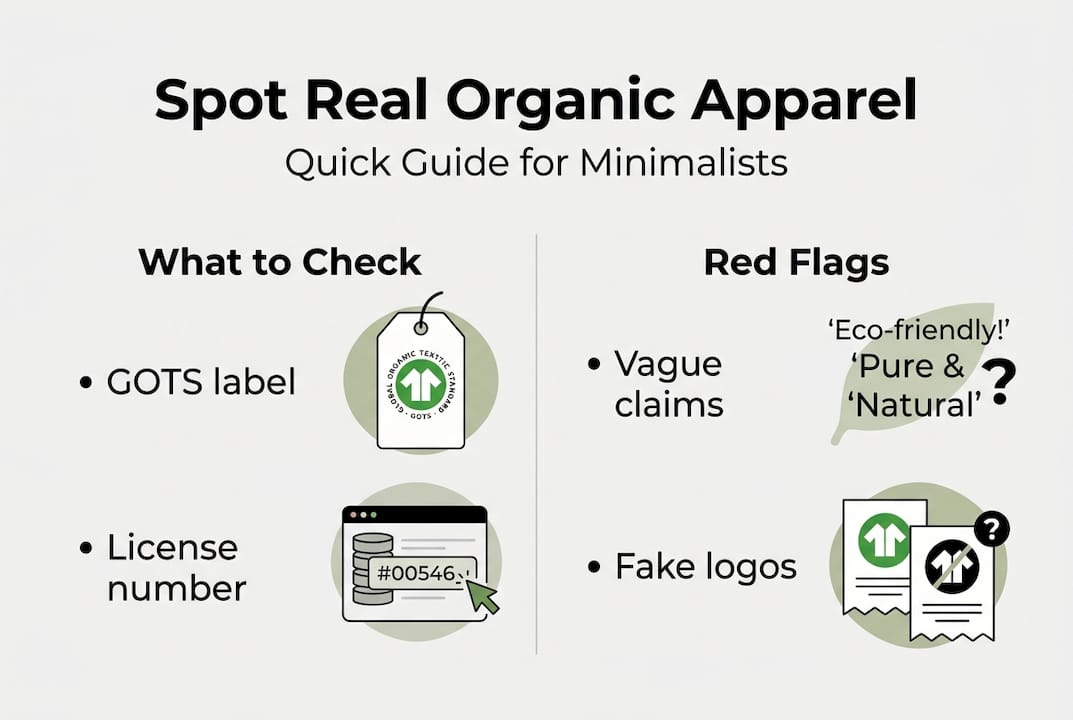
Vague organic claims without certification, fake logos, suspiciously low prices, and lack of transparency are the most common edge cases you’ll encounter. Each one deserves a closer look.
Watch out for these specific warning signs:
- No certification code or license number on the label or product page
- Generic “organic” language without specifying which standard or certifier
- Prices significantly below market rate for certified organic garments
- No supply chain information on the brand’s website
- Logos that look slightly off in design, color, or proportion compared to official versions
- No annual audit documentation available or referenced
- Claims that can’t be verified through any public database
The global organic cotton supply is finite. If a brand’s sales volume seems inconsistent with what certified organic production can realistically support, that’s worth questioning.
Fake logos are more common than most shoppers expect. Counterfeit GOTS or OCS logos sometimes appear on products from brands that were never certified or whose certification lapsed. Always verify through the official database, not just the visual appearance of the logo.
For a deeper look at what premium organic streetwear actually looks and feels like, understanding these red flags helps you recognize the real thing by contrast.
Aligning your values: Minimalist streetwear, EU compliance, and trusted brands
Understanding and spotting the traps is vital, but aligning your streetwear and minimalist wardrobe with both sustainability and style is the final, empowering step.
EU regulations and the Green Claims Directive require verifiable proof for any environmental or organic claim. GOTS certification aligns directly with REACH chemical safety standards, making it the most legally sound choice for European consumers. Brands that carry GOTS certification are already operating within the tightest regulatory framework available.
For minimalists, the approach is straightforward. Fewer pieces, better verified. Prioritizing trusted EU-based GOTS production delivers the lowest environmental impact and the highest confidence in what you’re wearing. A capsule wardrobe built on certified pieces is both a style statement and a values statement.
Here’s how to build that wardrobe with intention:
- Start with basics. T-shirts, hoodies, and sweatshirts in GOTS-certified organic cotton form the foundation.
- Prioritize EU-based supply chains. Shorter supply chains mean easier traceability and lower transport impact.
- Choose brands with public certification pages. Transparency is a feature, not a bonus.
- Use online verification as a habit. Check organic clothing essentials and cross-reference with certifier databases before every new brand you try.
- Look for brands that reference Stanley/Stella GOTS standards as a benchmark for their own sourcing.
Pro Tip: When building a minimalist capsule wardrobe, treat certification verification as part of the curation process. A piece that can’t be verified doesn’t belong in a wardrobe built on intention.
Discover truly authentic organic streetwear
Now that you’re equipped to spot authentic organic apparel, finding your next minimalist streetwear staple should feel straightforward rather than stressful. At MEXESS, every piece in our collection is sourced with certification transparency at the center of the process. We believe that premium organic streetwear should be verifiable, not just marketable.

Explore our curated range of authentic organic apparel including GOTS-certified T-shirts, hoodies, sweatshirts, and everyday essentials designed for city life. Each product page includes the details you need to feel confident about what you’re buying. And if you want to keep learning, our blog covers everything from fabric quality guides to styling tips for building a wardrobe that works as hard as you do.
Frequently asked questions
How can I quickly check if organic apparel is truly certified?
Look for the GOTS logo, certifier code, and license number on the label, then verify the license number in the public GOTS certified suppliers database. The process takes under two minutes.
Is OCS certification enough for authentic organic clothing?
No. OCS verifies organic fiber content and traceability but does not cover processing chemicals, dyeing practices, or labor standards. GOTS is required for full authenticity.
What are the biggest red flags of fake organic clothing?
Vague organic claims without certification codes, logos that can’t be verified in official databases, prices far below market rate, and no supply chain transparency are the clearest warning signs.
Why is authentic organic apparel important for minimalists and streetwear fans?
It ensures ethical sourcing, lower environmental impact, and aligns your style with verified sustainable values. GOTS certification guarantees organic from farm to finished garment, including chemical safety and fair labor standards.
Deixa um comentário